
Less than a minute Read
Suction and Blow Systems in Swimming Pool Halls

Category
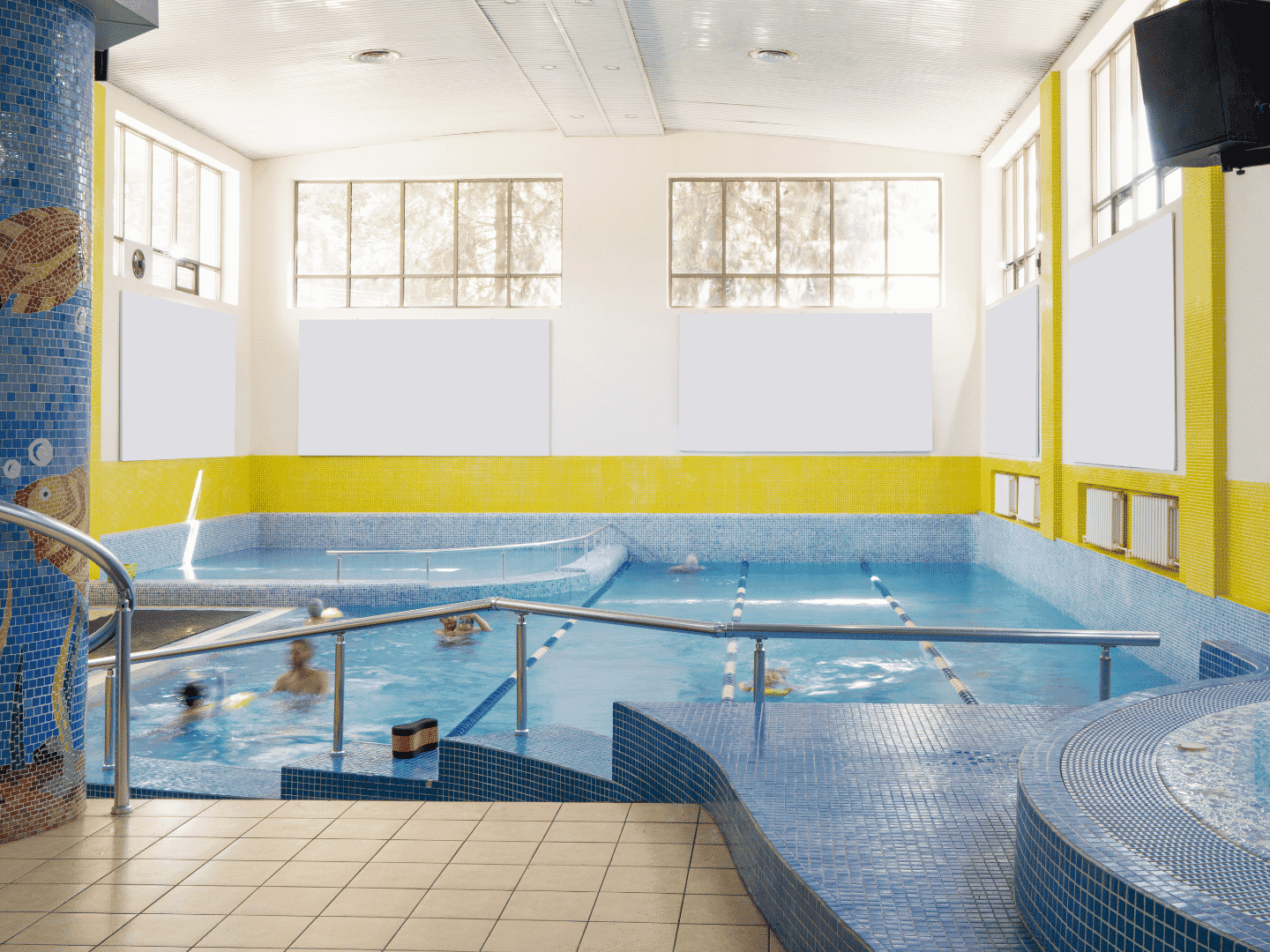
Suction and blow (S&B) systems are a swimming pool ventilation and dehumidification system that operates without the ductwork normally used to distribute conditioned air throughout the pool hall.
In a conventional swimming pool ventilation system, air leaves the air handling unit (AHU) and is distributed through a network of ductwork and grilles positioned around the pool hall.
The goal isn’t solely to heat the space, but to distribute conditioned air evenly throughout the building. Special attention is usually given to areas with poor air movement, like pool hall corners and perimeters, where stagnant air can raise local humidity and risk condensation, mould and building fabric damage.

A Fundamentally Different Approach
Instead of the usual ductwork, the supply and extract arrangements are concentrated close to the AHU, with the conditioned air discharged directly into the pool hall through high-velocity outlets.
These may typically be drum louvres, jet outlets or bullseye-type louvres. The outlets are selected to provide sufficient throw and entrainment (the process where a moving fluid or gas drags another substance along with it) to carry the air across the pool hall.
The main attraction of this arrangement is the potential saving in installation cost. Eliminating a substantial proportion of the supply and extract ductwork can represent a significant reduction in both material and installation costs, particularly in large pool halls where the ductwork system can be a major component of the overall mechanical services installation.
Why Is The Concept Now More Viable?
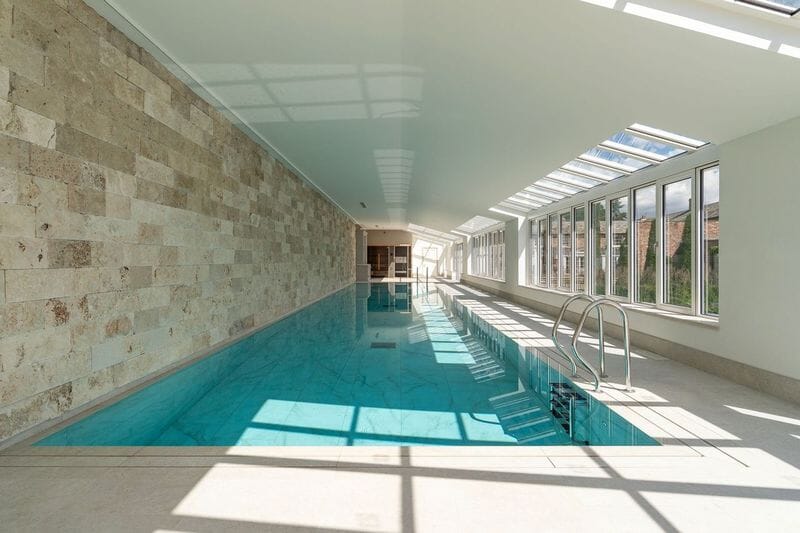
The use of S&B systems has become more attractive as the thermal performance of modern pool hall glazing has improved considerably.
15 years ago, a typical double-glazed panel might have had a U-value in the region of 3.2 W/m²·K. Modern double glazing can achieve U-values closer to 1.2 W/m²·K, depending on the specification.
With a lower U-value, the glass loses considerably less heat to the outside environment and therefore remains substantially warmer during cold weather.
Traditionally, supply air in a swimming pool hall has been directed specifically over the glazing to maintain internal glass surface temperature and prevent condensation, with the air flow also removing moisture from the boundary layer immediately adjacent to the glazing.
With modern, high-performance glazing achieving significantly higher internal surface temperatures, it may no longer be necessary in some applications to distribute supply air directly over every glazed panel solely for this purpose.
This does not mean condensation can be disregarded. Glazing specification, external design temperature, internal air temperature, relative humidity and thermal bridging at frames and junctions must still be considered. However, the improved performance of modern glazing provides greater flexibility in how ventilation air is distributed.
Advantages of an S&B System
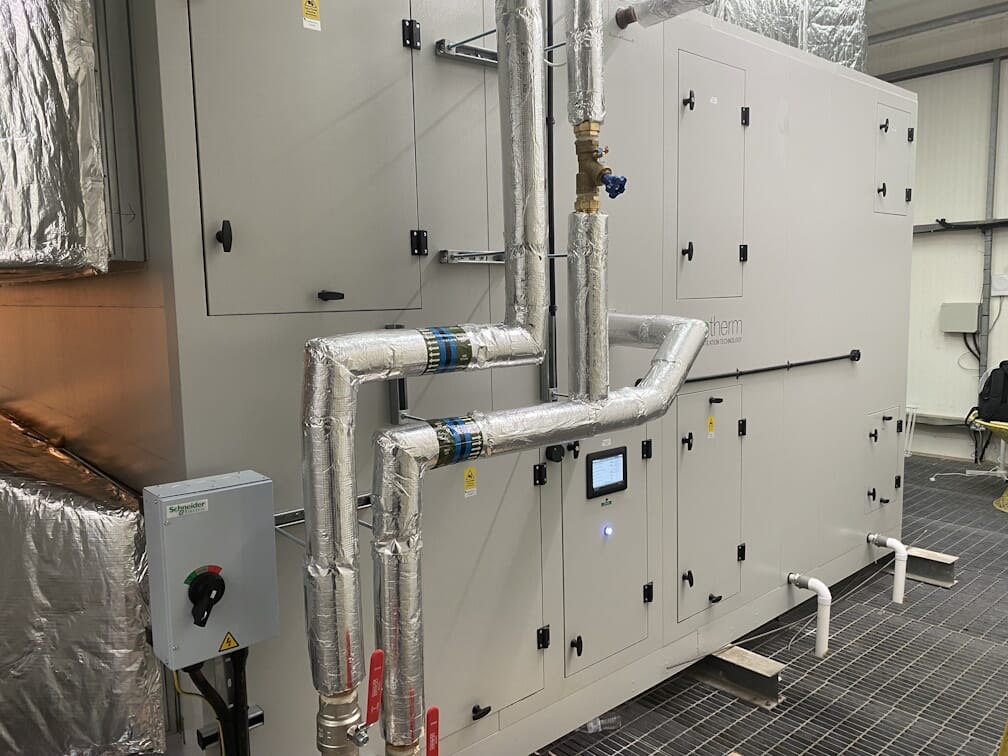
The main advantage is capital cost. Removing the distribution ductwork can substantially reduce the cost of the mechanical installation, however there are also secondary benefits, including:
- Reduced quantities of ductwork and associated fittings
- Less structural support required for ductwork
- Reduced installation labour
- Fewer service entries and builders’ work requirements
- Often simpler and quicker installation
- Greater flexibility where there is limited space for conventional ductwork
Capital vs Operational Cost
For a new pool hall where architectural and structural arrangements make ductwork difficult or expensive to install, these savings can be particularly attractive.
However, the reduction in capital cost needs to be considered against the potential operational and aesthetic disadvantages.
Air Distribution Is the Principal Limitation
The main technical disadvantage of an S&B system is that the air has to travel a considerable distance from a relatively small number of discharge points.
A conventional ducted system can introduce air at numerous locations around the pool hall. The designer can therefore control the air pattern and ensure conditioned air reaches areas that are particularly susceptible to high humidity or low surface temperatures.
With an S&B system, the designer relies heavily on the throw, velocity and entrainment characteristics of the discharge grilles.
The outlets must be carefully selected and positioned so the air travels across the pool hall and entrains sufficient air. The objective is to achieve good mixing without creating excessive air velocities in occupied areas, something that becomes increasingly difficult as the size of the pool hall increases. The greater the distance between the discharge point and the furthest end of the building, the more important outlet selection and air velocity become.
There’s also a risk of inadequate air movement in areas outside the main air pattern: corners, spaces behind structural elements, spaces beneath balconies or other locations shielded from the main air jet.
The design must therefore demonstrate adequate air movement throughout the pool hall rather than assuming a large volume of air discharged from one end of the building will distribute itself evenly.
Fan Energy and Variable Speed Operation
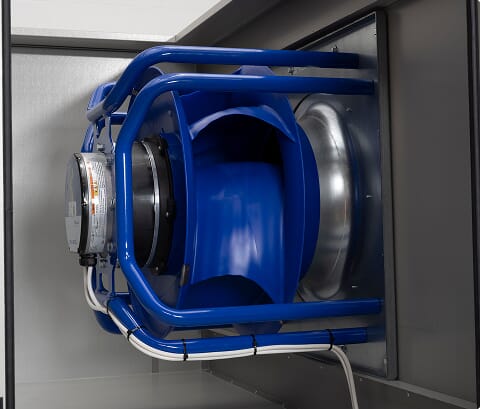
Fan power is highly speed-sensitive, so running a fan at reduced speed can save significant energy compared with running it near maximum output continuously.
An S&B system places greater demands on the fan since the air needs sufficient velocity at the discharge grille to achieve the required throw.
The fan may therefore need to run at a relatively high speed even when the ventilation or moisture load is relatively low. Reduce the speed too far and discharge velocity and throw will fall, risking poor air distribution.
This creates a potential conflict between energy-efficient fan operation and maintaining the required air distribution.
A conventional ducted system has much greater flexibility because the air is distributed through multiple outlets. The system can often operate effectively at lower fan speeds while still maintaining acceptable air distribution throughout the pool hall.
The energy penalty of an S&B system depends on its detailed design, but should be factored into whole-life cost rather than compared on installation costs alone.
Architectural Considerations
There’s also an important aesthetic consideration.
Architecturally, a conventional ducted system offers considerably more flexibility. Supply and extract grilles can be distributed around the pool hall and integrated into the architectural design, with ductwork itself concealed within the ceiling or building structure where possible.
Architects understandably prefer to minimise visible mechanical services, but a ventilation system can’t disappear entirely. An S&B arrangement makes this particularly apparent as discharge grilles must be large enough and positioned correctly to achieve the required throw.
This leaves the architect not only with visible grilles, but with grille positions dictated primarily by air distribution requirements rather than architectural preference.
Design Considerations
An S&B system shouldn’t be regarded as simply a conventional system with the ductwork removed. Removing the ductwork changes how the air distribution system has to be designed.
The designer needs to consider:
- Pool hall dimensions
Particularly the distance from the discharge outlets to the furthest parts of the pool hall - Discharge velocity and throw
Sufficient velocity must be maintained to achieve the required air pattern - Entrainment
The discharge air must entrain room air effectively to avoid excessive air velocities in occupied areas - Dead spots
Corners and areas shielded from the main air pattern must be considered - Glazing performance
The U-value and internal surface temperature of the glazing should be assessed rather than assuming air must be directed over every window - Condensation risk
Improved glazing does not eliminate the need to assess condensation, particularly at frames, mullions, junctions and thermal bridges - Fan energy
Assess the fan operating point and minimum practical speed rather than assuming variable-speed operation will save as much energy as a ducted system - Noise
Higher discharge velocities can increase grille-generated noise and should be considered in the design - Comfort
High-velocity jets must not create uncomfortable draughts in occupied areas - Maintenance and access
The discharge outlets and AHU should remain accessible for inspection, cleaning and maintenance
Balancing the Benefits
An S&B system can significantly reduce capital cost and, where properly designed, effectively ventilate a swimming pool hall without the expense of conventional ductwork.
Improved thermal performance in modern double glazing has made the concept more practical, reducing reliance on supply air directly washing the glazing to maintain surface temperature.
However, the system has disadvantages. Success depends heavily on achieving correct air throw and distribution from a relatively small number of discharge points, and it can limit the ability to reduce fan speed without adversely affecting air distribution, potentially increasing fan energy consumption during periods of low load.
There is therefore a clear distinction between capital cost and whole-life cost. An S&B system may be considerably cheaper to install, but the designer should consider its fan energy, noise, comfort, air distribution and condensation performance before concluding that it is the most appropriate solution.
From an architectural perspective, the conventional ducted system will generally provide the better solution because it allows the supply and extract points to be distributed and integrated into the building design. The S&B approach places much greater importance on the visible discharge grilles and, more importantly, on where those grilles can physically be located to achieve the required air movement.
Ultimately, the choice should be based on the particular pool hall, its dimensions, glazing specification, occupancy, ventilation load and architectural requirements. An S&B system can be a very effective and economical solution, but the saving in ductwork should not be achieved at the expense of proper air distribution.